When your business is making potato crisps, the one ingredient that you need lots of – apart from potatoes, of course! – is oil. When you’re producing 5000 bags of crisps a day, then oil is needed on an industrial scale.
It’s not a question of people marching around the manufacturing facility, wielding bottles of cooking oil. Far from it – the required oil is fed into the production process through a very sophisticated pipeline that extracts the exact amount needed per crisp. It’s a very exact science.
Oil storage facility
However, all that oil has to be stored somewhere. In this instance, it comes from three 5-tonne vessels. These are emptied and filled at regular intervals, so there is never a shortfall.
Ultrasyntec were actually engaged in installing new flooring systems for this crisp manufacturer when the new inquiry was made. How would Ultrasyntec build a structure capable of containing 15 tonnes of oil in three vessels? Whilst also ensuring its leak-tight integrity in the event of one of the vessels dropping a load.
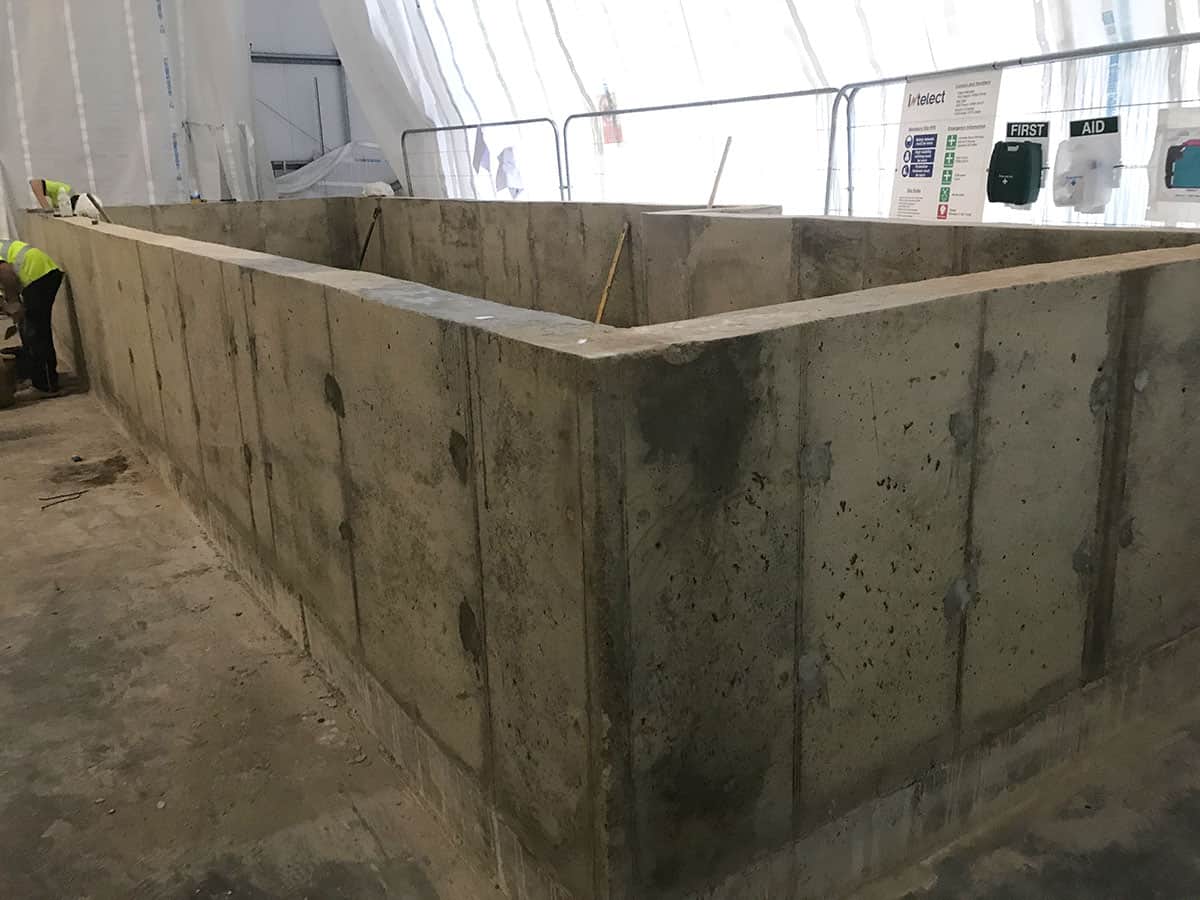
It was an interesting conundrum. Using the dimensions we were given for the three vessels and the position they needed to be held in, we designed an overall plan. We had to calculate the weight of 5 tonnes of oil should it drop out of the vessel. With all the relevant statistics, we were able to determine how high the bund wall should be to contain this amount.
What should the bund wall be coated with?
The next question was, what should we use to coat the concrete forming a bund liner so it achieves a 100% seal? Drawing on our many years of experience, we have put together a specification for the floor and bund wall.
The concrete floor measured 200mm in thickness, and the bund walls 150mm. From the date of concrete pouring, the client required the bund to be operational within two weeks. Allowing a standard three- to four-week concrete curing time was not an option.
A liquid-applied DPM was the answer
The answer was to apply a Damp Proof Membrane (DPM) primer to the concrete structure. This allowed the resin products specified as a bund lining to be applied without the risk of moisture left in the slab affecting the overall performance of the project.
Given that the flooring surface was subjected to significant loads, the Ultrasyntec team calculated that the best option was to use a heavy-duty polyurethane screed at a thickness of 10mm. Inside the bund walls, we trowel-applied a heavy-duty wall render at a thickness of 6mm. This would be capable of handling all proposed activities within the structure.

When the floor and walls were complete and fully cured, two coats of chemically resistant, UV-stable seal coat were roller-applied on, leaving the bund totally oil-tight and ready for service.
Project completed within an 11 day window
Ultrasyntec completed the project within the required 11-day time window. The resultant structure will last for decades to come. Furthermore, it will also retain its excellent aesthetics thanks to the UV-stable seal coat. Using a damp-proof membrane provides an excellent solution for similar applications on bunded oil tanks and oil storage bunds.